. Vite Vinifera De Vino's Blog

Friday, January 18, 2008

Is The Brain Taste Worst Enemy ?

A couple of days ago, a friend of mine sent me an email with an article about how certain cerebral information can (and almost always will) impair your taste judgment.
The article, written by Kathryn Westcott, can be found on the BBC website.
The piece explains in some noteworthy depth that scientific studies have proven tasters' judgment to be influenced by numerous unrelated factors about a wine, not the least of which is the bottle's price tag.
Back in November, I wrote a post about how corruptible and flaky the palate can be, and this study of the California Institute of Technology confirmed a great many of my suspicions. Those suspicions were further legitimized by a musing from the uber-taster, his eminence Robert Parker, when he stated:

"I really think probably the only difference between a 96-, 97-, 98-, 99-, and 100-point wine is really the emotion of the moment".
"The emotion of the moment," huh? Well then, I suppose my question is this: why do people still listen to wine experts, if the pinnacle of taste has more to do with our feelings than our palates? Perhaps we should be asking our shrinks instead.
In all seriousness: I'd like to first say that a price tag's influence on judgment of quality is no surprise. It is a byproduct of capitalism that occurs not just with wine and food, but with most of the goods we buy. Studies show that brands are better recognized when they are associated with higher prices. Secondly, the test was carried with 21 volunteers, but the group's mean level of experience was not known. And, as a car expert can determine the value of a car by inspecting its various parts and assessing its general condition, or a watch expert is capable of telling a fake timepiece from a real one, a wine expert will look for certain information coming from the wine itself when rating it. An average consumer or buyer of cars, watches or wines might not have those capabilities.
I was recently invited to a tasting with a blind format. I sat on a panel with much more experienced palates than my own, and collectively, the comments and ratings of the wines were so precise as to put them in a price category; one wine in particular, I recall was very good, all-around, and at the same time, we said that probably was among the less expensive of the bottles at the tasting. And, as a matter of fact, it was the cheapest one.
In addition to experience, the format of the tasting should also be examined. I can say (from experience) that there are many ways to taste, depending on the goal of the tasting. Blind format is good for honing the palate and removing biases of appellation and label.
If my goal is to evaluate the aging potential of a wine, I open a bottle and try it several times over a few days, and the wine's vital statistics (vintage, house, and price) are just used for reference. But as a merchant, if I'm tasting to buy a wine I like to have information, included the price, in order to weigh the price-quality ratio. From that standpoint, a wine could be uncommonly good if costs $6, but middling or average if it goes for $12.
So it is true, taste is often challenged by information, and it plays a large role in making decisions about what to buy. But the "experts," if I may be so bold, have different tools, experiences, and methods to taste a wine - memories of flavors and textures, and historical, geographic, climatic and geological instincts that will help provide an accurate and more precise judgment.
Buona Bevuta a Tutti

Wednesday, January 09, 2008

Joe Stone Crab Miami


Well, I did it - I finally took 3 days off , I closed the store and spent some time in Miami.
This was my first time there, and I must say that I thought it was a really beautiful place. I stayed in South Beach and had the chance to get some sun and swim the ocean before it got crazily cold... as a matter of fact, the low temperature on January 3rd was 38 degrees (does it get that cold regularly in Miami?). I had 3 priorities the first was to relax at the beach, which I did extensively on my first day (and briefly on the second one, as well). The third day, unfortunately, was too cold to even think about getting half naked, much less going outside and laying around.
The second priority was a visit to El Rey de la Guayaberas in the Little Havana district; the Guayabera, a style of shirt, was originally from Cuba but is widely used in the Caribbean islands, especially on "Spanish" ones.
I completed that task on the last day, but it was 47 degrees and, like I said, definitely too cold to lay on the beach anyway. I didn't meet "El Rey" Ramon Puig, but there were two lovely Cuban ladies that adopted me and chose the perfect size and shape of Guayabera, and in my favorite colors!
The third priority was a dinner at Joe Stone Crab!
The story of this famous joint started in 1913 when Joe Weiss moved to Miami and opened up a small restaurant when Miami was still an insignificant and quiet backwater town. After running a lunch stand at Smith's Bathing Casino, he and his wife bought a small bungalow on Biscayne Street and set up eight tables on the front porch; that was the year 1918.
Joe was in the kitchen while Jessie, his wife, tended to the eight tables, their specialties were Pompano, Mackerel, Snapper and some meat dishes. Things got busy quickly for them, partially because they had no competition, but mostly because of the tremendous fish sandwiches Joe's diligently made. They started to use their living room to put more tables up and they opened for breakfast, lunch and dinner.
The famous Stone Crabs came around few years later, in 1921 when James Allison opened an aquarium near Joe's restaurant. Jessie, Joe's son, used to go for fun, and check out their research on the local crabs, called Stone Crab. One day James brought 4 crabs to the restaurant and asked Joe to cook them, and after few arguments on how they should be prepared, grilled, broiled and so on Joe just took and threw them in boiling water and that was it. They were exquisite and Joe, who hadn't believed that the crabs could sell, hit the jackpot... because Biscayne Bay was full of them.
Today fishing Stone Crabs is regulated in order to keep a healthy number of them around. I had Joe's Stone Crabs several times in New York. They actually ship it next-day air, and very well packed, so they're always fresh. But the experience of being there is another story. The place was packed and the wait was up to 2 hours; my good friend Luciano, thank god, knew somebody that knew somebody else that had a table ready for the 4 of us. We got the infamous crabs paired with some Alaskan king crabs and some hash browns, Joe's style, deliziosi!!!
The claws were juicy and filled with meat, they were sweet and yet you could taste the sea, creamy and slightly salty, delicate and persisting. They were a real treat, and in fact, I'm salivating just thinking about it.
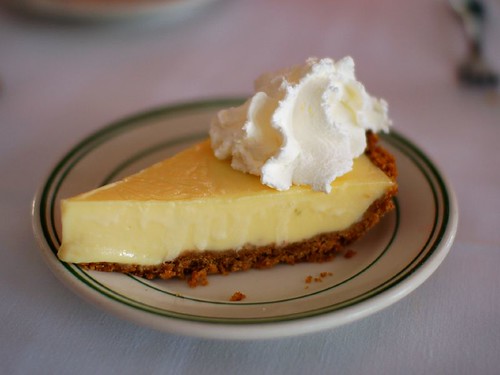
To drink, Luciano played it safe ordering Laurent Perrier Rose`. Pale orange reflections with very small and light bubbles, scents of berries and citrus with a lingering finish went great with the crustacea and also with the mayonnaise and mustard-based dipping sauce. The dinner finished with a tray of dessert, the highlight of which was the Key Lime Pie made with limes coming from the keys, hence the name, that had unique sweet citrus flavors.
It was so good that the next day I went to their take-away side and got a box with 5 pounds of claws, and proceeded to fight them through the almost ridiculously tight airport security and Continental Airline rules and regulations about transporting ice, just to have them again back in NYC.
Buona Bevuta a Tutti

Thursday, December 27, 2007

Alcohol is rising!!! It is just because of the climate?


I have, in the window of my store, some bottles from different vintages of Ridge Montebello. I call the window my cemetery, because it is where the bottles I've killed find their final repose. The Montebello is fantastic wine - I'm a big fan of it, and I drink it whenever I have excuse to do so. And then sometimes when I don't.
A few days ago Matt was browsing through the graveyard, perusing the evidence of exploits past. For those that don't know Matt, he is a young but skilled connoisseur that helps me in the store and has edited many of the posts on this blog for me, including this one. While he was browsing the Montebello corpses, he noticed a big difference in the wine's alcohol content, lighter in older bottles and higher on more recent vintages. In 1977, for instance, the percentage by volume was 11.7, and 12.9% in 1988. It climbed to 13% in 1999 and 13.2% in 2003. He mentioned global warming as explanation for the constant alcohol escalation, which does play a big part, in light of the direct proportion between sugar and alcohol. In fact, through the fermentation process the sugars are transformed directly into alcohol with the help of enzymes contained in the yeast. But is it just that... or there is more?
I remembered a conversation I had with a winemaker a while ago, regarding the help that science has contributed with grape clone selection, making more information available to agronomists, in order to select the best clones for the area of production. This information variably increases the quality and the health of the grapes. A big breakthrough happened along these lines in Montalcino, where it has been discovered that Sangiovese Grosso wasn't the best clone for Montalcino conditions and soils. In the past 30 years, the weather has gotten warmer but the grapes got healthier, the grains got smaller, and the vines got older, losing some vigor but gaining concentration and potency. Concentration of the grape from water distress coupled with better and older vines result in a higher content of polyphenols, which is a good thing for a wine. It also results in higher sugars and lower acidity levels which is not so good (distressingly high alcohol levels, and wines with shorter aging potential). Today I think we are in a sweet spot where the climate is more temperate. In Piedmont, for instance, we had a stretch of 6 good to excellent vintages from 1996 and 2001. The level of technology gave the winemakers more information than ever, including the latest creation of the grape's genome map. If this is like drinking a wine at its peak, let's hope we are still far from descending.
Buona Bevuta a Tutti.

Monday, December 24, 2007

Buon Natale


Monday, December 17, 2007

Omaggio a Valentino Migliorini


Valentino, owner of Rocche dei Manzoni, passed away last Thursday leaving a hole in the Langhe. Modern and passionate Barolista will be missed by all the Nebbiolo lovers.
Buon Riposo

Wednesday, December 05, 2007

Lost Flavors

Sometimes a normal, unassuming evening can turn into a time warp experience: it happened to me on Saturday night.
First I have to provide you with an introduction to my first experience with Luciano Madii aka Il Frasca. I met him over ten years ago in Montevarchi with my brother in law, amidst our self-proclaimed crusade to the Prada outlet. Our journey fulfilled, we unassumingly asked the Carabinieri at the autostrada tollbooth where we could eat a good lunch before the outlet opened. The two of them, almost in unison said "Il Frasca. Make a right, then a left after the bridge and then follow the signs." That is exactly how we unassumingly got to "Il Frasca sull'Ambra."
The restaurant was filled with Prada managers and designers (the factory is few minutes away from the restaurant) and every table was taken, so we waited unassumingly by the bar.
Meanwhile another Prada manager who looked very hurried stepped in after us, hoping for a table. I told Frasca that we were not in hurry, and that we had to wait for the outlet to open anyway, so we could wait for the next one if he wanted to give it to the gentleman after us. That is how we unassumingly became friends, and we spent the whole day with him, only to be invited for dinner at his other restaurant "La Valle dell'Inferno".
A word about the man himself - Il Frasca is an excellent chef with over 30 years of experience. He now owns two restaurants in the Valdarno, La Valle dell'Inferno with his residence connected and la Fiaschetteria where his nephews Riccardo and Daniele run the show. He also owns an establishment in Coconut Groove in Miami. Since that first fateful day, I have eaten at La Valle dell' Inferno and the Fiaschetteria numerous times and always had the best meals. Luciano was in NY last week and stayed with us for couple of days including the unassuming Saturday, the evening that he turned into a great and memorable experience, through a warm, comforting and soothing Ribollita.
La Ribollita, literally meaning "reboiled" because of its second passage in the pan to finish the dish, is sort of a bread soup made with kale, beans, carrots, onions, celery, garlic, herbs and extra virgin olive oil. It is a pretty simple dish, a reminder of the poor roots of the classic Italian cuisine. But trust me, when Robollita is done right, it's like a symphony of flavors in the mouth.
If you go to Tuscany, every little town and every person in the town will keep the secret of how to make the a perfect Ribollita. Some put more vegetables than others, some create a little crust when reboiling, etc, etc. I'm sure one could write an entire book with all the variations and the variations on the variations of Ribollita. The Tuscans, perhaps by nature, have a very efficient networking system, but do not allow it to mar their pride for their own specific creations. As Fabio Giannotti of La Fornace, winery in Montalcino once told me: "my Brunello is the best, but I talk with other winemakers about lots of things, especially when a "friend" has a problem and need information in how to deal with it." The same unassuming networking principle also works with recipes:" my Ribollita is the best but tell me one thing - how do you get the crust so crispy like that..."
So, that Saturday I came home from the shop, and Frasca, Luciano's friend Il Pimpi (in Tuscany more than anywhere else they use nicknames religiously) and my sister were waiting for me to eat a big pot of Ribollita. Luciano took few big spoons put in a pan and started to reboil it, then put it in four plates, landed some thin slices of onions over the top and drizzled some olive oil on it. I poured some Tenuta Vitalonga Elcione for everybody then we all sat, ate and started to travel through time and space, following the hands that made those simply delicious flavors throughout the centuries.
Buona Bevuta e Mangiata a Tutti

Sunday, December 02, 2007

Dinning Out The Little Howl

It took me a little while, a year and a half, to finally go and pay my respect to Joey Campanaro, Chef/Owner of the Little Owl in the West Village. I met Joey several years ago when he was working at The Harrison, a restaurant right below my apartment in Tribeca. As I said I was long due to go there and savor the delicatessen Joey is capable to prepare, so Last Wednesday I'd decide to finally go and check it out. The place is fairly small but very welcoming, the kitchen is enclosed by glasses where Joey can check the dining room, there was a very inviting and enticing scent of home cooked food which in my opinion is always a good sign.
I was welcomed with a nice glass of Prosecco by Chris while Joey was waiving from behind the glass in kitchen, and after few minutes he sat us in a spacious and comfortable table, kind of amazing considering the size of the place. The menu is short but tempting I had hard time to choose from few succulent appetizer like the white risotto with egg yolk and truffles (my partner in crime choose that), the lobster soup (which was my choice), the duck breast with cranberry sauce, endive and walnut pesto or the crispy artichoke so popular that by 9 they already were out of it. The risotto was cooked to perfection (al dente) with enough white truffle on to make it a luscious plate, the lobster was flavorful with big chunks of tail in a little spicy broth. As entrees we both got the Lamb Chop; succulent, juicy, tender and flavorful. Once again the meat was perfectly cooked, served with cheese gnocchi, that almost melted in my mouth, and watercress onions salad.
To go with that I choose a nice bottle of Bordeaux Chateau de Lavaud 2004 full bodied and more new world style with some noticeable flavors of vanilla and strong fruits blending pretty well with the lamb. I must say that the Little Owl is a great little jewel hidden in the heart of the west village fairly priced that makes you feel like at home; I will soon be back to discover more from the menu.
I suggest you to make a reservation ahead of time being the space very limited; ideal for romantic dinners or small groups.
Sorry for the bad quality of the pictures I did took those with my phone...
Buona Bevuta a Tutti