. Vite Vinifera De Vino's Blog

Saturday, February 24, 2007

What makes wine age longer

There are 4 major elements that give wine the ability to age:
the tannins, the PH, the alcohol and the sulfites.
Tannins are molecular antioxidants that are present in the majority of trees and fruits. In grapes there is a higher concentration of them in the stems, seeds and the skins, commonly called the "dregs." The tannins are transferred into the wine during the maceration, when the wine is in contact with the dregs.
Acidity also plays a big role in the aging process. An alkaline wine with a high PH level, say for instance, a buttery California Chardonnay, will have a lower capacity for ageing than acidic wines with a lower PH. The acidity also acts as an antioxidant.
The alcohol in wine has a familiar task, acting as an antiseptic and a preservative, just as it does in medical science. This helps to keep the wine safe and uninfected by harmful bacterias.
The sulfites are the final antioxidants in wine. They are present in nature, and are sometimes added in small amounts, usually to stabilize a wine.
The main component in preserving the life of a wine is the same as it would be in any living thing - electricity. Tannins, like all molecules, retain an electric charge. By utilizing that charge, the tannins capture oxygen molecules in the wine, creating a sort of protective shield. The tannins can also be transferred into the wine from the barrels in which the wine is fermented. In this case, the wood will give an additional modicum of electric charge to the wine, enhancing its antioxidant properties. Connected to the tannins are flavonoids called anthocyanins and leucoanthocyanins (more antioxidants), which are also responsible for the wine's color; the first results in a purple color, and the second is white.
It is also very interesting to see how the barrel plays a role in the color of a wood-aged red wine. The barrel, as previously stated, will transfer significant electric charges to the wine that strengthen the anthocyanins, and make them show an almost blue color.
These excess charges, in addition to strengthening the wine in a general sense, also help to shorten the chemical chain of the wine's tannins. If the chain were to get too long and heavy (a danger to which it is highly susceptible, especially after long maceration on the skin) it makes the tannins sink to the bottom of the barrel, where they are discharged with the dregs, robbing the wine of its ageing potential. This is why simply having wine in contact with the grape skins doesn't guarantee a higher content of tannins unless they are refined and recharged by wood.
So - a wine with the right amount of sulfites (too much will give a rotten egg flavor to the wine), a good amount of charged tannins with wood to balance out their chemical chains, and a lower PH level will allow the bottle to live for several decades.
Here's an example for you to try, to experience the influence of the PH levels in a wine; see how a barriqued Chardonnay tastes different when it comes from California or Sicily. Then compare it to a Chablis or a Chardonnay from Trentino Alto Adige. The first will have a higher PH level, resulting in fat, buttery, soft, round texture and a shorter life, where the Chablis, which will retain a very low PH level will have sharp, crispy, fresh texture, and the possibility to age for 30 40 years.
Last but not least, the sulfites, naturally produced during the fermentation of a wine, are another powerful antioxidant. If used in moderation, they can only expand the wine's life. But if overused, they can and will "kill" the wine, again with the "rotten eggs" flavor.
Regarding the sulfites - I remember a very inspirational story regarding Stanko Radikon, a winemaker from Friuli-Venezia Giulia.
I had the pleasure of meeting the Radikon family, and had dinner at il Buco with different vintages of the Ribolla Gialla, Oslavje and Oslavje Riserva. They also brought a bottle of Oslavje vinified with added sulfites, and one from the same vintage that was sulfite-free (starting with the 2002 vintage all his production is without added sulfite)
The one without added sulfites was more open and ready than the other. The bouquet was firmer, to say the least. This makes sense, because technically, the wine with added sulfites was 5 years behind the one without. Interesting, eh?
In closing, I would like to apologize for my prolonged silence - it took quite a while to try to simplify a very complex chemical process from a slough of Italian words that are not translatable.
Stay tuned for the second part of the aging experience.
Buona Bevuta a Tutti


Tuesday, February 13, 2007

What was the name of that wine...


Often, my memory skills are challenged by my costumers; just few minutes ago, two girls came in and told me: "I bought a white wine some time ago that was very good - it had a pear taste, it was around $21, and I'm sure you were the one that recommended it."
I was reminded of when I used to DJ, and I would go to my local record shop and try to sing the song I wanted, something I had heard somewhere, and I usually received, as consequence, a puzzled look from the shop's owner.
It happens quite often that someone purchases a bottle of wine and likes it - I usually do too. But when they return to pick up the same bottle some time later, they can't remember the name, grape, appelation, or even the color of the label - all things that might help me to figure out which bottle they are talking about.
Sometimes after few minutes of asking questions and pointing at bottles I do find the wine they loved, and they leave happy to have picked up something they know they will like. But other times, finding the right bottle is a task for Tom Cruise (Mission Impossible).
I used to tell people to write down the name of the wine or producer, or to bookmark it on the De Vino website. But notes with wine names on them get misplaced and mixed up, and people aren't always coming from home, where they can check the website. Then, all of a sudden one day, a brilliant idea struck me like lightning, and I asked a costumer: "do you have a camera in your phone?"
Most of the time the answer is yes, and I always suggest taking a picture of the wine you like. Considering that you will always carry your phone with you, it will be the easiest way to create a wine database.
And now, you can also download your pictures onto your computer and create word documents with pictures, notes and anything else you like to include in your archive.
I've been suggesting that to a lot of people and it looks like it works and is a pretty accessible system for the majority. I now have a few costumers that send me email with pictures of wine they had, and want me to look for.
It's also helpful when I select a mixed case for my out-of-town costumers - they can send me emails with pictures and feedback on what they liked (or didn't like, which it doesn't happen very often thank god).
So remember - if you find something you really like, and you'd like to have it again, take a moment to snap a photo on your cell phone. It'll almost certainly save you time and puzzled looks.
Buona Bevuta a Tutti

Wednesday, February 07, 2007

It's Getting Hot in Here

I drank a 2004 Nebbiolo Langhe few weeks ago while I was watching the Al Gore's movie, "An Inconvenient Truth." While I was watching it, a terrible thought crossed my mind; if it gets too warm, what is going to happen with traditional wines like Barolo and Burgundy? They grow in such specifically mild climates and settings, after all;
are these going to be the last vintages of these great wines?
Should I stock and keep them because there is not going to be any more?
Those are terrible thoughts, enough to give me chills as I'm writing. Some things have already changed - for example, the peanut in Italy used to be grown exclusively in the south, because in the north the climate is too cold. Now the peanut is grown widely in the "Pianura Padana," (Piemonte, Lombardia and Veneto) which was unthinkable a decade ago.
I' ve been reading several articles on the subject, and two of them struck me as particularly relevant:
one was about California and how in the next 20 years, with the current trend, the conditions to grow grapes there will no longer exist. In fact, already the alcohol content of most California wines is very high; hotter weather will result in higher sugar content and less water in the grapes. This natural occurrence has advanced to the point where wineries are now investing large sums of money in very expensive Spinning Cone Column machines, or in the painstaking process of reverse osmosis to remove a certain percentage of excess alcohol (euphemistically described by the Conetech Corporation as "volatile flavor components") from wines.
The other article was on the "Repubblica" website and prophesied a pretty sad scenario in the south of Italy's near future; the article analyzed the first effects of global warming in the Mediterranean region, and shows that those effects will likely lead to the loss of some important income sources.
The rising temperature will lead tourism to more northern and cooler areas like Croatia, the north of Italy the Atlantic coast of France, Portugal and Spain. This will almost certainly result in an economic disaster, which will only aid the land's descent toward desertification. The scariest part of the situation is that the region is projected to be just 10 years away from the point of no return, and to invert the process will be very difficult.
Pietro Colla, chief winemaker of Poderi Colla winery told me that in 2006 he harvested his Dolcetto at the beginning of September, almost a month earlier than usual, and that the alcohol measured out to 15 % in some parts of the estate (nearly two points higher than is normal for Dolcetto). Gianluigi Maravalle, owner of Vitalonga estate, told me that the 2006 was among the hottest years in the recent past: but more importantly, he had to delay the pruning of his vines by couple of months because the plants didn't "shut down," or go into dormancy. He also has rose bushes on the side of his property road which are still in bloom at the beginning of February.
Oddly enough, we are not the only ones in the universe experiencing a rapid increase in temperature. Jupiter has now a new "stain", Saturn has a hurricane in his south pole, and the atmosphere of Triton, one of Neptune's satellite, is thickening because of their own global warming.

Friday, February 02, 2007

Bernard Faurie Saint Joseph 2002


Since 1980, the amiable and enthusiastic Bernard Faurie has slowly built up his Domaine, with holdings in Les Greffieux and Le Méal of just over 0.5 hectares to nearly two hectares. Bernard is patiently awaiting the construction of a brand new cellar but in the meantime he has to make do with his current one, which doubles as a general storage area. This can often prolong tastings quite dramatically as Bernard scrambles over an assortment of objects from trampolines to tricycles in order to get from one cask to the next. However, his wild, typical and traditionally-made examples of Hermitage and Saint Joseph really do make it worth the wait, both wines packed with aromas of violet and flavours of crunchy, powerful and spicy hedgerow fruit.
"Wait" seems to be a key word with Faurie's wines, as I experienced little while ago.
I opened up a bottle of Saint Joseph 2002 few months ago, not knowing what I was getting myself into...
I opened the bottle out of curiosity, still being fairly ignorant and uninformed regarding French wines. At first, the wine was showing an incredible amount of acidity that almost felt like carbonation on the tongue, and the tastes were going everywhere like a chicken without a head. It was not so pleasant I must say, but there was something about it that was telling me to wait.
And that's exactly what I did - I waited for 3 hours and had another sip from the first glass I had poured myself.
It seemed as though it had become another wine! Now the acidity was gone, leaving space for the raspberries flavors and some hints of green herbs.
It was still very tight, however, and the tannins were astringent - the bottle was acting like a grumpy old farmer that doesn't warm up easily to strangers.
At this point, I was convinced that this was a matter of being patient and seeing just how long it would take to get to the heart of the heart of the wine.
So, I called it a day. I covered the neck with a napkin, secured it with a rubber band and left it alone until the next evening.
Day 2 , a little over 24 hours after opening;
That evening, the old grumpy farmer living in the Saint Joseph was ready to tell me all kinds of stories; tales of terroir, and the unrelenting difficulties of the year 2002 with prolonged rain and flooding, and how, in order to achieve the highest possible quality, the master hand had to cut, reduce and sacrifice in order to make just a few good bottles.
Now, the wine was perfectly balanced, elegant, the tannins were sweet, firm - nothing like they'd been the day before.
At this point the wine was close to its peak, but still seemed to have some more time in front; so I left it alone for another day.
Day 3 over 48 hours after opening.
Finally, that evening the wine had stopped developing and was starting the curve of descent, still enjoyable but lacking some of the complexity I had previously enjoyed. There were some oxidation notes, and the finish was not as persistant as it had been before.
This was the first time that I encountered a wine that opened so very slowly, and it would lead me to think that that vintage can be in the bottle for at least another 15 to 20 years - I will try it again by the end of the spring, and see what the grumpy farmers of the Saint Joseph have to say in a new season.
Buona Bevuta a Tutti

Monday, January 29, 2007

Super Bowl Wines


Whether you're looking for Peyton and the Colts to go all the way this Sunday, or you're ready to see the Bears victorious in their first Super Bowl in over two decades, there's one thing about this weekend's game that everyone can agree on - Super Bowl parties.

For many, a cold beer or a simple mixed cocktail will do for Super Bowl Sunday - they certainly do serve as a great compliment for a bowl of pretzels or a sweet sausage nacho cheese dip. But for those who want to put their feet up with a nice glass of wine during the party, we have a few suggestions that might be too tantalizing to pass up.

Medici Ermete Lambrusco, "Grasparossa," 2005 a slightly sparkling chilled red, Lambrusco is a perfect Super Bowl drink. Boasting a dry, cleansing palate of blackberries, raspberries and roses, Lambrusco is quite the companion for barbecue chicken wings and potato chips,

Montesel Prosecco di Conegliano "Riva dei Fiori," 2005 An uncommonly elegant and historical prosecco, presumed to be from the Hills of Japheth, the third son of Noah, who according to Genesis, discovered the art of winemaking. Impeccable scents of fruit and white flowers mark this smooth sparkling wine, with an overwhelmingly clean effervescent palate, perfect for washing down lil smokies and the dip-adorned crudité that are sure to be gracing the country's coffee tables.

Buona Bevuta a Tutti

Thursday, January 25, 2007

Another Late Night

I was very happy to spend some time with Roberto Cipresso, after a year or so apart. In my short wine life, I have had few mentors; people that drastically made an impact on my wine education. They are my father and mother, who kindled the process; Luciano Maddi AKA Il Frasca; and of course, Roberto, holder of the title of winemaker of the year awarded by the "Associazione Italiana Sommelier" and author of Il Romanzo Del Vino. He and I met up for the first time here in New York, at a friend's house. I remember blind-"tasting" something like 25 bottles of wine between 5 of us (not a bad way to start a friendship...). After that, I had the chance to work with him on a project in Sicily and the pleasure to share the 2002 harvest in Mendoza with Achaval Ferrer.
Needless to say the amount of information I've learned from him was huge, but one thing in particular had a resounding impact on me; I had learned the human side of the wine, the famous hand behind it; I saw how a great wine is made from the initial stage of an unborn idea until is mature in the bottle - he showed me the emotional side of the nectar of the gods.
Last Wednesday, Roberto and Daniel Oliveros had invited me for dinner at La Masseria in midtown.
The theme of the night was Cotes du Rhone and the lineup was pretty intense. There were 7 of us at the table, and guests included: Mary Ewing Mulligan, the editor of Wine For Dummies, and her husband Edward V McCarthy; Laurie, who works with Daniel; and Daniel's wife Natalie, who joined the table just shortly after we arrived. (I have to interrupt myself momentarily, just to say that after I saw Natalie, it took me good 5 minutes to regain focus on the wine I was sipping)
The Oliveros make a series of wine with Roberto
called Sogno, the first one (Uno) is a red, based in Cesenatico (a grape that grows in Lazio). the second, which will be released in the near future, is a Falanghina; they also have the "Tre" and "Quattro" in progress (contents undisclosed).
Going back to the dinner - we were welcomed with 2 bottles of Louis Roederer Champagne from 1990. There was an interesting difference between the 2 bottles; the first was more austere and probably showing more hints of age than the second, which had fresher flavors of berries. Then we started in on the reds; they were all very good, showing complexity and highlights of terroir and old vines. Jean Louis Chave, Chaputier and Bernard Faurie were among the stars of the evening. Chave's wines, Hermitage from 1998 and 2000, were full, open, and bursting with character, a bouquet of intense berries balanced
by austere tannins and the spiced flavors derived from the terroir. Bernard Faurie was more enigmatic and closed with strong minerality - we had the Hermitage 1995 vintage. Chaputier was somewhat in the middle of the two. After a while, I must say that the experience became a little blurred and overwhelming; with so many good wines, it was hard to focus and remember. So I can say that also the Levet' s Cote Rotie and the 1985 Cornas were impressive, but beyond that, the details start to get a little hazy in my memory.
The last bottle was something I could not forget; Chateau d'Yquem 1921!!! What to say - just the emotion of looking at that golden juice gave me the chills. The wine was still fresh over 85 years after its bottling - it had lost most of its sweetness, and had left citrus flavors of grapefruit and candied orange peel. As the wine opened up in the glass the more typical flavors of dried apricot also started to show.
It was a memorable night for the company and the amazing wines we drank, so memorable, in fact, that I really didn't mention anything about the food, which was very good, but surpassed by everything else.
That night was about friendship and strong relations that last long like a standing promise.
Grazie Daniel and Natalie for the wonderful evening and grazie Roberto for fueling my passion.

Tuesday, January 23, 2007

From Patagonia with Passion


This is the story of a dream that it has materialized in a bottle of wine.
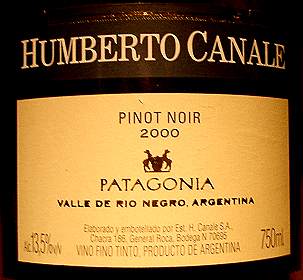
The story starts as usual in a glass shared with friends, that is what Piero Incisa della Rocchetta did in Argentina. " I had tasted a Pinot Noir that Hans (Vinding Diers) had made for Humberto Canale (a Rio Negro Specialist) and the wine hunted me".
Here is when the pursuit for the dream took him in a magical place were he found 85 acre vineyard with Pinot Noir plantings from 1932, 1955, 1967 and 1999.
Historically the Rio Negro has been the fruit growing center of Argentina, producing particularly apples. Chalky soil combined with a long ripening season under clear skies make it an ideal home for vineyards.
I had the "treintados" few night ago at Il Posto Accanto, which by the way is now open on Mondays, had it with my friend Piers, an English gentleman, Burgundy lover and connoisseur.
We opened the new released 2005 and decanted it, we had a little taste in the glass while we let the nectar breathe oxygen.
We appreciate the color with deep purple reflection, the nose filled with violet and herbal scents, in the palate the soft and yet firm tannins cleaned the palate for the long persistent finish of pure terroir.
Although the wine was still a baby, because of the age of the vine, it was already showing complexity and the secondary flavors of exotic spices, minerals and rose petals.
We waited until the food arrived, some amazing Oxtail Ravioli, to keep experiencing the bottle.
The wine kept opening losing some of the boise flavors and strangely enough showing firmer tannins, I must say that the pairing with the Ravioli was sublime. Piers comment to the wine was "extraordinary" I felt the same way. The wine is highly allocated and very expensive($ 120 plus shipping if you can get it from the winery I sell it for $ 160); little more than 2700 bottles and 150 magnums were produced in 2004.